Compare
What AI engines search for on the web, the sources they read, the brands they cite and the traffic they send you: compare your brand with your whole market.
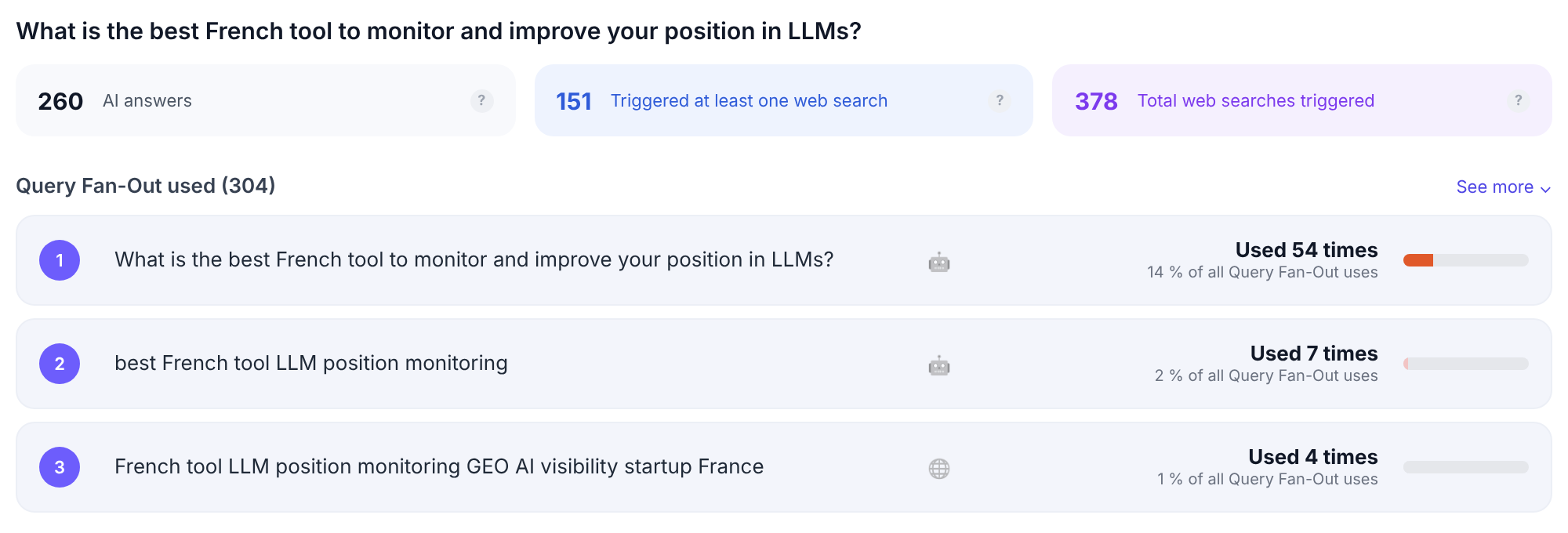
To answer a prompt, an AI engine often runs its own web searches. Query Fan-Out reveals these queries, how often they are used and which AI engines trigger them: you know which searches you need to be visible on to make it into the answer. A high rate means the AI has to look things up on the web, a low rate means your brand is already anchored in its knowledge.

“What is the best French tool to monitor your position on LLMs?”
Comparisons, press articles, forums: the pages that rank on these searches.
The AI cites the brands found in these pages. If you are not there, you are not in the answer.
What Meteoria shows you
Web search rate
The share of AI answers that triggered at least one web query, and the total number of searches run.
Web queries per prompt
Every query triggered, its usage rate and the AI engines that use it.
Product and local queries
The shopping searches behind ChatGPT product carousels, and the Google Maps searches behind local recommendations.
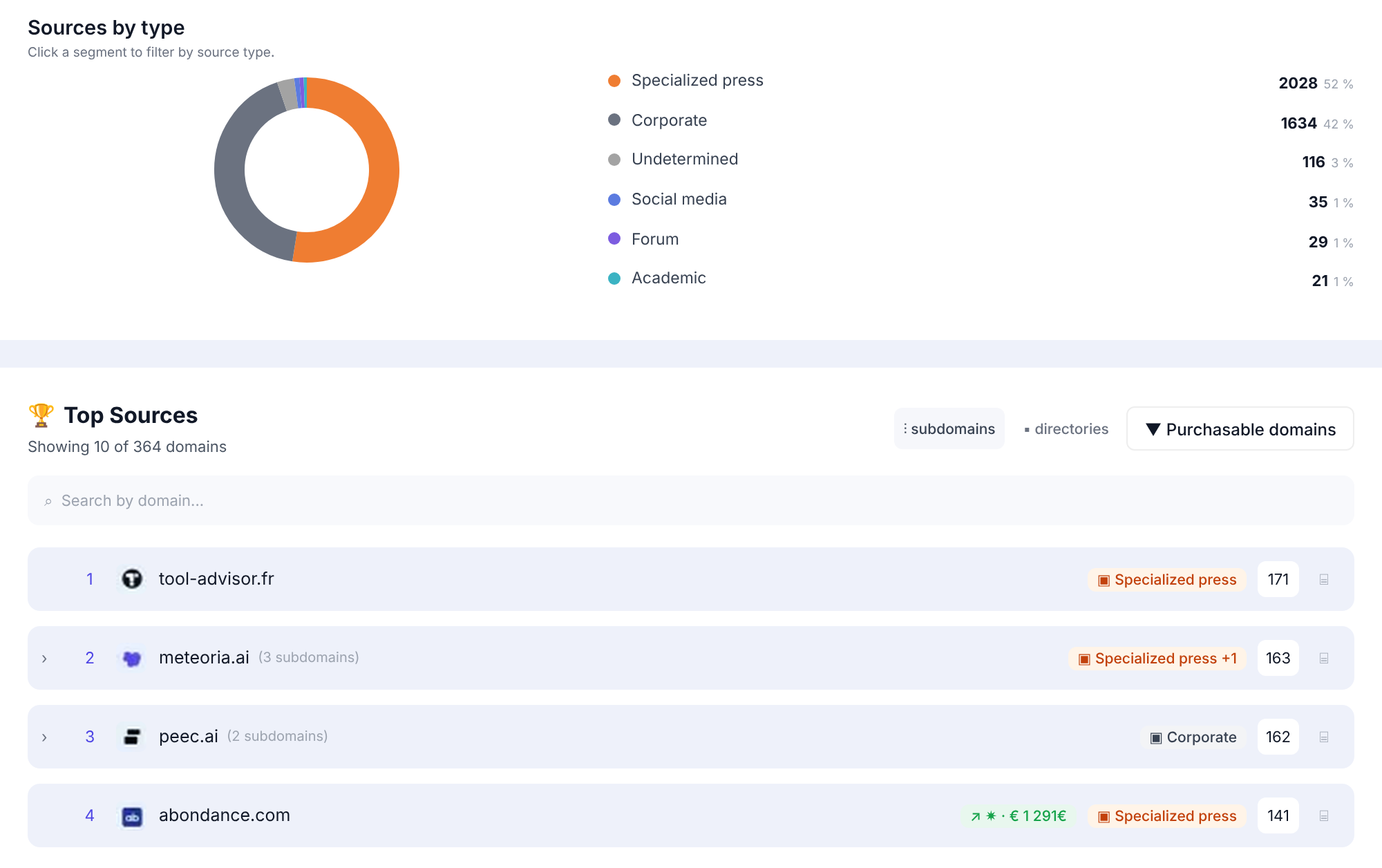
AI engines build their answers from web pages. Sources & citations shows which ones: the domains and pages they cite, their type, and the share of answers where your own site is one of the sources.
On its web searches, the AI goes through comparisons, press articles, forums and product pages.
Some of these pages are cited as sources of the answer: they shape what the AI says about your market.
Your site, your competitors, the press, forums, review sites: Meteoria counts every source, answer by answer.
What Meteoria shows you
Your source rate
The share of AI answers that cite your site as a source, and how it changes over time, AI by AI. You can also track a specific section of your site, such as /blog.
Top domains and source types
The most cited domains and their breakdown by type: trade or general press, forums, review sites, wikis, social networks, corporate sites, academic sites, marketplaces.
The cited pages
Every URL used as a source, how often, whether your brand appears on the page and which competitors it mentions. Exclude your own or your competitors' domains to keep only third-party sources.
The sources you are missing from
The pages that cite several of your competitors, but not you. Spot the ones available for purchase on Getfluence or PopRise, or request a quote directly from the publisher.
The Competitors tab shows which players capture AI attention: when a user looks for the best solution, who gets recommended first? Your brand, a competitor or a comparison site?
Competitive matrix: every brand detected in AI answers, with mentions, visibility and position.
Competitor ranking by share of voice, with search within the ranking.
Daily visibility curve per competitor and mentions per platform: ChatGPT, Gemini, AI Overview.
The overlap matrix shows which brands AI engines cite together most often, based on shared prompts.
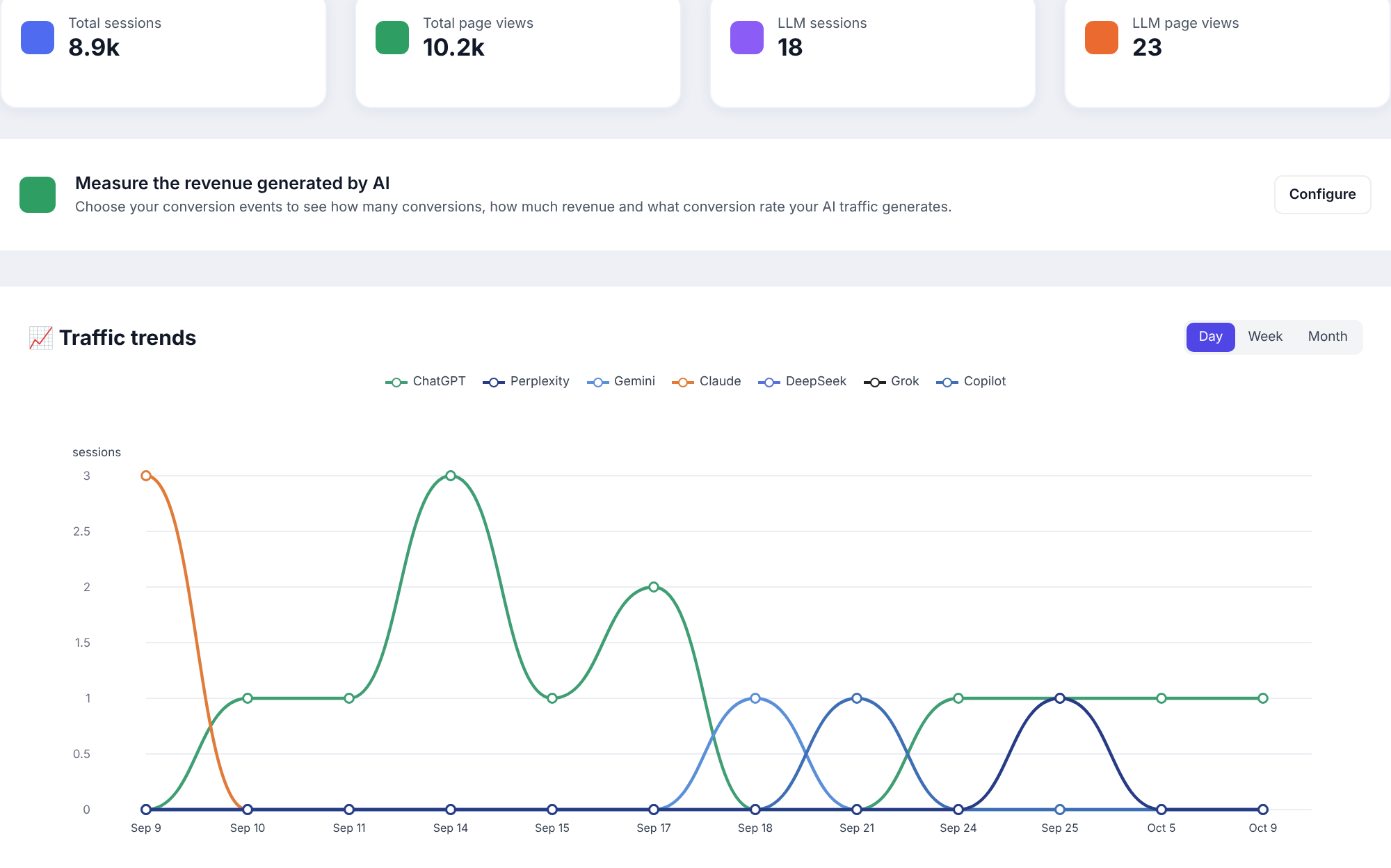
Measure the visits and revenue attributed to AI answers. Meteoria connects your AI tracking to your analytics tools to see what share of your traffic and conversions comes from ChatGPT, Perplexity, Gemini, Claude, Copilot or DeepSeek.
Table of the AI sources driving visits to your site, with sessions and page views per assistant.
Choose your conversion events to measure the revenue, number of conversions and conversion rate generated by your AI traffic.
Data from your connected analytics tools: Google Analytics 4, Matomo, Piano, Amplitude, Adobe Analytics, Piwik PRO.
Track the AI bots crawling your site (GPTBot, ClaudeBot, PerplexityBot…) and your most visited pages. Advanced+ plan.